

A Passive House consumes over 90% less energy than a conventional building.
- The standard is optional, but internationally recognized in over 120 countries.
- The 5 principles: thermal insulation, thermal bridge-free design, airtightness, high-performance windows, heat recovery ventilation.
- Passive Houses in Romania have heating bills of 400-600 lei/year for areas of approximately 150 sqm.
- A Passive House does not need a gas boiler. The technical room is smaller, and the equipment is simpler.
A Passive House is a lazy house. It doesn’t make an effort to stay comfortable. In short, that’s the whole philosophy.
If we compare it to a car: a normal car consumes 5 liters per 100 km. A Passive House is the equivalent of one that consumes 500 grams. At that level of consumption, the type of fuel you use becomes almost irrelevant. Diesel, gasoline, LPG, sunflower oil. The same applies to a house: if the energy requirement is so small, how that energy is produced no longer matters as much.
And yet, many confusions have accumulated around the term “Passive House.” That it’s a house without electricity. That it’s an experimental house. That it would cost a fortune and look strange. None of this is true.
The concept emerged in the late 1990s in Germany. Not from builders, but from two physicists who sought methods to reduce the energy consumption of buildings. Germany was then facing a resource crisis, and the answer came from physics, not engineering. Five simple principles, inspired by how nature and the human body function.
What a Passive House actually means
A Passive House is a building that reduces energy consumption by over 90% compared to a conventional building. Not through sophisticated equipment, but through its design and construction.
The Passive House standard is optional. No one is obliged to build to this level. But it is internationally recognized in over 120 countries and comes with a rigorous certification process, managed by the Passivhaus Institut in Germany. Certification is done
based on a very well-established protocol, which verifies every detail of the building: how much it loses, how much it gains, how much it consumes.
Unlike nZEB, which is mandatory in Romania from 2023, a Passive House is a choice. But it is a choice that comes with stricter requirements and measurably better results. A Passive House needs 2-3 times less energy than an nZEB building.
In Romania, Passive House certification is not yet officially recognized as an equivalent nZEB standard. But the certification process is more rigorous than today’s nZEB. It will get there.
The 5 Principles of a Passive House
The Passive House philosophy rests on 5 principles. They are not complicated. In fact, they are logical if we think of them on the scale of the human body.
1. Generous Thermal Insulation
When we go skiing, we dress warmly. Why? To conserve body heat. It’s exactly the same for a house. The better insulated the thermal envelope, the less energy we lose.
In a Passive House, the thermal transfer coefficient for walls must be below 0.15 W/sqm·K, compared to 0.25 for nZEB. In practice, this means at least 25 cm of thermal insulation on walls, a minimum of 30-40 cm for the roof, and about 20 cm for foundations.
A Passive House can be built using any construction system, but timber frame structures make it easier to achieve the required values. 15 cm of mineral wool can be integrated into the structural walls, over which cladding and another 20 cm of rigid insulation are added on the exterior.
2. Elimination of Thermal Bridges
No matter how good the insulation, if it’s interrupted somewhere, heat will escape exactly through that point. It’s like a ski jacket that’s two centimeters shorter than the pants. An exposed midriff negates all effort.
Classic examples: foundations poured directly into the ground without insulation. Balcony slabs that penetrate the thermal insulation. Sills, lintels, unprotected corners. The argument “the ground keeps it warm” doesn’t hold up. It’s warmer than the air, but losses are constant. We don’t go skiing in flip-flops. For a house, an uninsulated foundation is the exact equivalent.
3. Airtightness
The warm air in the house contains energy. To reach 20 degrees, we consumed something: gas, electricity, pellets. If this air escapes uncontrollably through gaps, cracks, or weak joints, energy is lost. It’s like a jacket with a broken zipper. Good material, but if it doesn’t close, it’s useless.
In a Passive House, the airtightness level must be a maximum of 0.6 air changes per hour at 50 Pa, compared to 1.5 for nZEB. The blower door test is mandatory, and the result appears directly on the certificate.
4. High-Performance Windows
Windows are often the most expensive element in a house. Prices range from 200 to 1,000 euros per square meter. For 20 square meters of windows, we’re talking anywhere between 4,000 and 40,000 euros. For that kind of money, it’s worth having a tool that tells you where to place the window, how large it should be, and if it’s chosen correctly.
In a Passive House, the thermal transfer coefficient for windows must be below 0.85 W/sqm·K, compared to 1.11 for nZEB. But beyond the U-value, the energy balance also matters: each window is calculated individually, for each facade, with local climatic data. The goal is for that window to gain more energy from the sun than it loses on sunny days.
Sometimes, during the design process, windows are moved, enlarged, reduced, or rotated to another facade. It’s an iterative design. But ultimately, each window is placed where it works for the house, not against it.
5. Heat Recovery Ventilation
In winter, we keep the windows closed. Naturally. But the air in the house still needs to be changed. How do we bring in fresh air without losing all the heat?
The heat recovery ventilation system operates on a simple principle, inspired by nature. Two sets of ducts, like two honeycombs, intersect. Warm air from the house exits through one honeycomb. Cold outside air enters through the other. Heat exchange occurs through the walls between the two honeycombs. The air does not mix or contaminate; it only transfers its temperature.
Current systems recover over 90% of the heat. If it’s 20 degrees inside and minus 10 outside, the fresh air enters the house at about 17 degrees, not minus 10. The energy effort decreases massively: we heat by 3 degrees, not 30.
In a Passive House, this system is mandatory; it must be a certified component and must have an efficiency of at least 75%.
How much a Passive House consumes in practice
The figures are not theoretical. They come from houses built, inhabited, and monitored in Romania.
Passive Houses of approximately 150 sqm have annual bills between 400 and 600 lei for heating and cooling. Not with special equipment, but with correct thermal insulation, good windows, airtightness, and heat recovery ventilation.
A Passive House in Bragadiru, near Bucharest, has no heating system. None at all. When it’s colder, the occupants plug in a space heater or an electric radiator. That’s it. One winter, they went skiing and left the windows with the blinds open. In January, the house registered 21 degrees. Free heat from the sun.
An office building of 2,400 sqm in Oradea, built on the same principles, consumed 8,800 lei in electricity for heating for an entire year, for 120 people. That is 3.6 lei per square meter per year.
What installations does a Passive House have?
The first confusion made is that an energy-efficient house needs complicated installations and a technical room the size of a garage. It’s exactly the opposite.
A 24 kW apartment gas boiler occupies a quarter of a technical room. The equipment of a Passive House, with an installed power of about 8 kW, can serve the same house but occupies much less space. The technical room is smaller precisely because the energy requirement is lower.
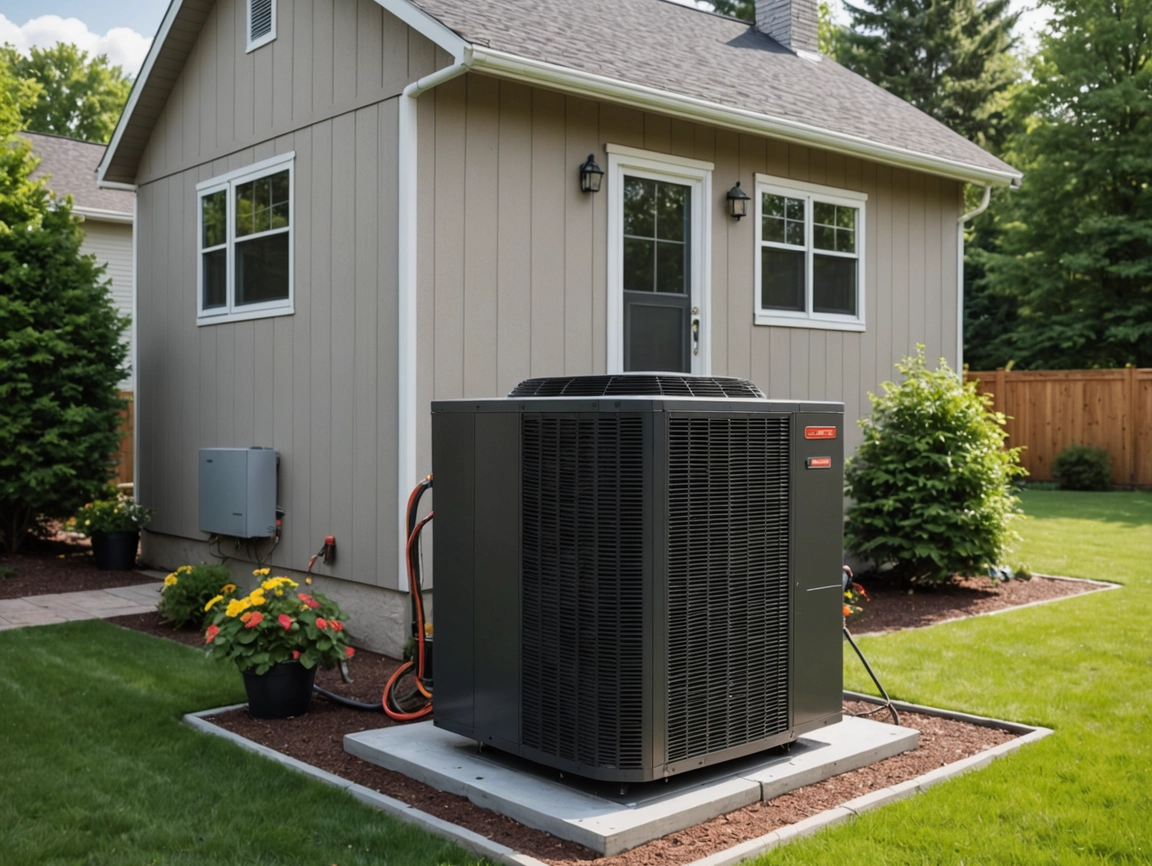
The heat pump replaces the gas boiler. The ventilation system is the only additional equipment compared to a conventional house. And what happens when it breaks down? The fan is like a laptop fan. That’s all the technology that consumes electricity.
The market has matured enormously. 10 years ago, it was difficult to find a heat recovery ventilation system on the Romanian market. Today there are dozens of manufacturers, including those who manufacture in Romania. The same applies to heat pumps. The important thing is to choose a manufacturer with a service network, not one that makes a few pieces in a garage.
Maintenance is simple. Filters are changed periodically. Windows need annual adjustment, regardless of whether it’s a Passive House or not. Dust gets in and damages the mechanisms, just like a car that needs its filters and oil changed at every service. Many pieces of equipment connect to the internet and can be monitored remotely. The manufacturer calls and says: “you need to change the filters” or “the fan is consuming more than normal.” Complete traceability.
Passive House, Plus, and Premium
Since 2015, the Passivhaus Institut has introduced an update to the standard. If we choose exclusively renewable energy sources, we can achieve a higher classification: Passive House Plus or Premium.
The difference from the basic standard: renewable energy production reported to the building’s footprint. The logic is simple. On a one-story or 10-story house, the same roof area allows for a maximum number of photovoltaic panels. That’s why the energy produced is reported to the built area, not the usable area.
A concrete example: a premium Passive House of 170 sqm usable area, with approximately 150 sqm footprint, has a primary energy demand of 29 kWh/sqm/year, but can produce 136 kWh/sqm of footprint per year. It produces 4 times more energy than it consumes.
If the same house had been built only to the nZEB standard, the photovoltaic panels would have covered about 80-90% of the requirement. It would have exceeded the nZEB requirement, but it would not have come close to the 4 to 1 ratio.
How Passive House relates to nZEB
nZEB is mandatory. Passive House is optional. But the two converge.
A basic Passive House is not necessarily nZEB, because it is not required to have photovoltaic panels or to produce a certain percentage of renewable energy. The purpose of a Passive House is to reduce energy demand as much as possible.
An nZEB house is not necessarily a Passive House, because the requirements are more relaxed for insulation, airtightness, and windows.
But a Passive House Plus or Premium is definitely nZEB. It produces energy, consumes little, ticks all the boxes.
And the direction is clear. The European Union mandates that nZEB requirements increase every 10 years. In 2030, 45% renewable energy. In 2040, over 60%. In 2050, over 80%. Practically, in 2050 nZEB and Passive House will be one and the same. In the meantime, we are given intermediate steps to get there gradually. Anyone building to the Passive House standard today is, in fact, anticipating the requirements of 25 years from now.
I have written more extensively about what nZEB means, the requirements in the methodology, and what it specifically entails, in the dedicated article about nZEB.
Questions you may have after this article
Can I build a Passive House using any construction system?
Yes. It can be built with brick, AAC, reinforced concrete, or wood. Timber frame structures make it easier to achieve the values required by the standard, because the insulation is integrated directly into the wall structure, but it is not the only option.How much more does a Passive House cost compared to a conventional house?
The difference varies depending on the project, but it is usually between 10% and 20% of the construction cost. The investment is recouped through long-term energy savings, and the necessary equipment is smaller and cheaper to operate.What do I do when the ventilation system breaks down?
The market for components and servicing has grown significantly in recent years. The fan is a simple component. Large manufacturers offer remote monitoring services and service networks. It’s like a car: there’s a maintenance schedule, filters to change, periodic adjustments.Is a Passive House worth it in Romania?
Passive Houses built in Romania demonstrate with real bills that yes, it is. Romania’s climate, with cold winters and hot summers, means that reducing energy consumption has a concrete and rapid impact. And as energy prices constantly rise, the investment becomes increasingly relevant.
What is the main difference between a Passive House and nZEB?
nZEB sets a mandatory minimum performance threshold and requires 30% renewable energy. Passive House is an optional standard, but with stricter requirements for insulation, airtightness, windows, and ventilation. A Passive House consumes 2-3 times less than an nZEB building.
At nZEB Expo, there are concrete discussions about Passive Houses, nZEB buildings, and solutions that work in the Romanian market. Companies are there, specialists are on stage, and the information is practical, not theoretical. If you are planning a new construction or a serious renovation, this is the place to leave with answers, not more questions.

What is a Passive House and how does it work in practice
A Passive House consumes over 90% less energy than a


